
DIY vs. Ready-Made Natural Skincare: Benefits, Risks, and Effectiveness
Natural skincare appeals to people who want to simplify their routines and understand what they apply to their skin. Some prefer making face masks and scrubs at home, while others choose ready-made products containing botanical extracts, plant oils, and other skincare ingredients.
But which option is safer and more effective? Can homemade skincare provide the same benefits as professionally formulated products?
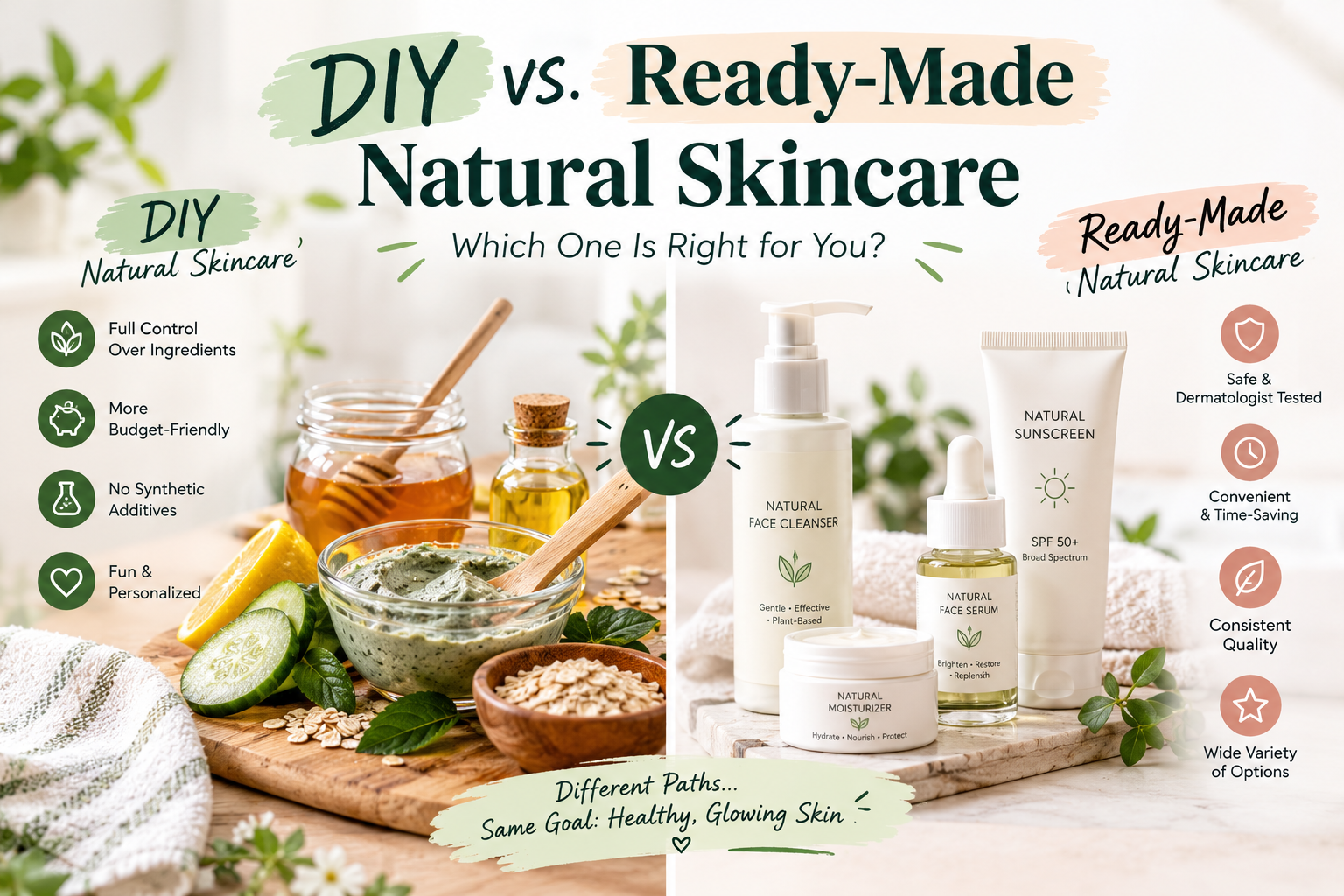
The answer depends on the ingredients, their concentrations, the formulation, and how the product is prepared and stored. However, well-formulated, properly tested ready-made skincare products generally offer more reliable safety, stability, and performance.
Let’s compare both options to help you make an informed decision.
What Is DIY Natural Skincare?
DIY natural skincare involves making products such as face masks, scrubs, and other preparations at home using ingredients like honey, oatmeal, aloe vera, yogurt, plant oils, and herbal infusions.
People often choose this approach because it can be inexpensive and allows them to control the ingredients.
Some ingredients may provide temporary skincare benefits. For example, colloidal oatmeal can help soothe dry or irritated skin when used appropriately. However, homemade preparations can vary in quality and effectiveness depending on the ingredients, proportions, and preparation methods.
Without proper formulation and storage, some mixtures may also irritate the skin or become contaminated.
What Is Ready-Made Natural Skincare?
Ready-made natural skincare includes commercially manufactured cleansers, moisturizers, serums, and other products that may contain botanical extracts, plant oils, and naturally derived ingredients.
Unlike a simple homemade mixture, a professionally formulated product can be developed with specific ingredient concentrations, suitable preservatives, stabilizers, and a pH appropriate for its intended use.
Depending on the product, these measures can help maintain its quality, consistency, and safety throughout its intended shelf life.
However, the term natural does not automatically mean that a product is safe or effective. Its quality depends on the actual ingredients, formulation, manufacturing standards, and testing.
DIY vs. Ready-Made Natural Skincare: Key Differences
|
Feature |
DIY Natural Skincare |
Ready-Made Natural Skincare |
|
Ingredients |
Selected and mixed at home |
Listed and formulated for a specific product |
|
Preservation |
Often lacks a tested preservation system |
May contain preservatives appropriate to the formula |
|
pH balance |
Often unknown unless measured |
Can be adjusted and tested |
|
Consistency |
May vary between batches |
Designed for consistent quality |
|
Effectiveness |
Depends on ingredients and preparation |
Can provide more predictable results when properly formulated |
|
Cost |
Often inexpensive to prepare initially |
Varies by brand, ingredients, and formulation |
|
Convenience |
Requires preparation and careful handling |
Usually ready to use |
Both options have advantages and limitations. The main difference is the degree of control over formulation, preservation, and product performance.
1. Which Is Safer for Your Skin?
Both homemade and commercial skincare products can cause irritation or allergic reactions. However, DIY preparations may present additional challenges because their ingredient concentrations, hygiene, and stability are often not tested.
Potential risks of DIY skincare
Homemade mixtures containing water, fresh aloe vera, dairy products, or herbal infusions can support microbial growth if they are not prepared and stored appropriately. Contaminated products may cause skin irritation or infection.
Some common household ingredients can also harm the skin when used incorrectly:
- Lemon juice: May cause irritation and increase the risk of sun-related skin reactions.
- Baking soda: Its high alkalinity can disrupt the skin's natural protective barrier.
- Undiluted essential oils: May cause irritation or allergic contact dermatitis.
- Coarse sugar scrubs: Can irritate the skin, particularly when rubbed aggressively.
Natural ingredients are not automatically gentle or suitable for every skin type.
Why ready-made products can be more reliable
Reputable manufacturers can use controlled production processes, ingredient specifications, stability testing, and appropriate preservation systems to reduce safety risks.
Nevertheless, commercial products can still contain irritating ingredients or trigger allergies. Choose products from reputable sellers, review their ingredient lists, and follow the manufacturer's instructions.
2. Which Provides More Effective Results?
Effectiveness depends on the skin concern you want to address and the ingredients used in the product.
A homemade mask may temporarily soften or soothe the skin, but this does not mean it can reliably treat acne, reduce pigmentation, or improve signs of aging.
Professionally formulated products can deliver specific ingredients at appropriate concentrations while helping maintain their stability.
For example:
- Dry skin: A suitable moisturizer can help reduce moisture loss and soften rough skin.
- Acne-prone skin: Products containing ingredients such as salicylic acid may help manage certain types of acne.
- Uneven skin tone: Formulated products containing ingredients such as niacinamide may help improve the appearance of pigmentation.
- Sun protection: Commercial sunscreens are developed and tested to meet applicable protection standards.
Results depend on the formulation, skin type, and consistency of use. A product's effectiveness should be judged by its ingredients and supporting evidence, not simply by claims that it is natural or organic.
3. Why Does pH Balance Matter in Natural Skincare?
Your skin has a protective barrier that helps retain moisture and defend against external irritants. Its surface is naturally slightly acidic, and unsuitable skincare products may interfere with this barrier.
Homemade recipes rarely include reliable pH measurements. Mixing ingredients without understanding their properties can produce a preparation that is too acidic or alkaline for its intended use, potentially causing irritation.
Professionally formulated products can be adjusted and tested to achieve a suitable pH for their purpose.
This does not mean every commercial product is perfectly formulated or suitable for everyone. However, proper formulation and testing provide a level of control that is difficult to achieve with an untested homemade mixture.
4. How Do Shelf Life, Stability, and Hygiene Compare?
Skincare products can change over time. Ingredients may separate, certain active compounds may break down, and microorganisms may multiply under unsuitable conditions.
Water-containing homemade mixtures are particularly challenging because they can support microbial growth without an appropriate preservation system. Refrigeration may slow some forms of microbial growth, but it does not guarantee that a mixture is safe.
Commercial skincare products are generally developed with an intended shelf life and storage instructions. Depending on the formulation, manufacturers may conduct stability and preservation testing to help ensure that the product remains suitable for use under specified conditions.
Even commercial products can become contaminated or deteriorate if stored incorrectly or used beyond their recommended period.
Before purchasing any skincare product, check the packaging, expiry information, storage instructions, and seller's reputation. For homemade preparations, avoid assuming that a mixture is safe to store simply because its ingredients are natural.
5. Which Is More Economical: DIY or Ready-Made Skincare?
DIY skincare may seem cheaper because you can use ingredients already available at home. It also allows you to prepare small quantities according to your preferences.
However, costs can add up if ingredients go unused, preparations spoil, or a mixture causes irritation. Homemade skincare also requires time for preparation, cleaning, and storage.
Ready-made products may cost more upfront, but they offer convenience and a consistent formulation. Prices vary widely, so a higher price does not automatically mean better quality.
To compare costs fairly, consider the product's size, ingredients, intended use, shelf life, and suitability for your skin rather than focusing on price alone.
6. Which Option Should You Choose?
DIY skincare may be suitable for occasional, simple preparations when the ingredients are appropriate and the mixture is handled safely. For example, an appropriately prepared oatmeal-based mask may help soothe dry skin temporarily.
However, homemade mixtures are not a reliable substitute for products that require precise concentrations, effective preservation, or tested performance.
Ready-made products are generally the more practical choice for:
- Daily cleansers and moisturizers.
- Water-based products that require effective preservation.
- Skincare products designed for acne or uneven pigmentation.
- Products containing active ingredients that require careful formulation.
- Sunscreens that need reliable, tested UV protection.
If you have sensitive skin, persistent acne, eczema, or another skin concern, consider consulting a dermatologist before experimenting with homemade treatments.
When shopping for skincare, check ingredient lists, product instructions, and the seller's reputation. You can also learn how to check skincare product authenticity before choosing where to shop.
Frequently Asked Questions (FAQ)
-
Is natural skincare safer than synthetic skincare?
Not necessarily. Natural and synthetic ingredients can both be safe or irritating, depending on the ingredient, concentration, formulation, and individual skin sensitivity. The word natural alone does not guarantee safety.
-
Can homemade face masks damage your skin?
Yes. Ingredients such as lemon juice, baking soda, undiluted essential oils, and abrasive scrubs may irritate the skin or disrupt its protective barrier. Even familiar food ingredients can cause reactions in some people.
-
Do homemade skincare products need preservatives?
Water-containing skincare products may require an appropriate preservation system to prevent harmful microbial growth during storage. Refrigeration alone does not guarantee safety. Without suitable formulation and testing, it can be difficult to establish how long a homemade mixture remains safe.
-
Are ready-made natural skincare products always safe?
No. Commercial products can still cause irritation or allergic reactions. Choose products from reputable sources, review their ingredients, and follow the instructions on the label.
-
Can DIY face masks eliminate acne and dark spots?
Homemade masks are not reliable treatments for persistent acne or pigmentation. Some ingredients may worsen irritation. For ongoing skin concerns, consider evidence-based skincare products or advice from a dermatologist.
-
Is it safe to make sunscreen at home?
Homemade sunscreen cannot reliably guarantee its SPF or broad-spectrum protection without appropriate testing. Choose a commercially manufactured broad-spectrum sunscreen with SPF 30 or higher and follow its application and reapplication instructions.
Final Thoughts
DIY natural skincare can be appealing because it offers ingredient control and may cost less initially. However, homemade preparations can have unpredictable concentrations, uncertain pH levels, and contamination risks, particularly when they contain water.
Well-formulated ready-made skincare generally offers more consistent quality, appropriate preservation, and more predictable performance. This makes it a practical choice for daily routines and specific skin concerns.
Ultimately, choose skincare based on its ingredients, formulation, evidence, and suitability for your skin—not simply because it is labelled natural. A simple, consistent routine with appropriate products is often more useful than experimenting with multiple untested remedies.